Notes On Time Travel
Time travel is probably impossible. But with evocative surroundings and a romantic imagination, is it really?

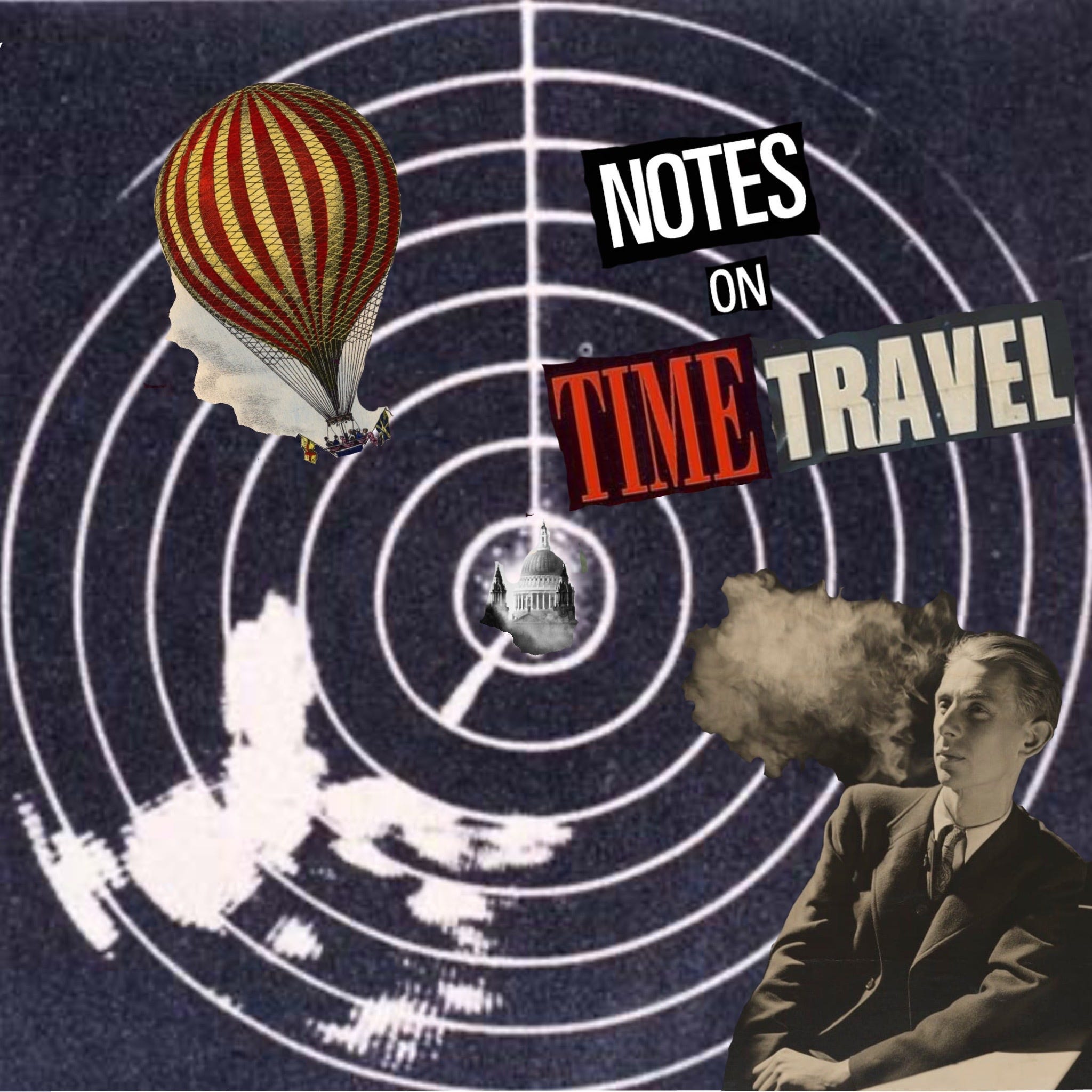
Time travel is probably impossible. But with evocative surroundings and a romantic imagination, is it really?
London has changed so much in the last twenty years. Even in the last ten, the total time in which I have lived in the city, some areas have transformed entirely.
One area that has stubbornly not changed, despite all the renewal around it, is St Pancras Old Church Yard near King’s Cross. In fact, the mourners who turned up to bury famed architect Sir John Soane there in 1837, in a telephone-box-shaped tomb, would probably still recognise it today.
As would The Beatles, who 57 years ago this week, turned up at the church yard for an ad-hoc photoshoot during their famous “Mad Day Out” trip around London.
One of the more famous pictures from that day depicts the band in the yard with a bleak looking building behind them, surrounded by colourful hollyhocks.
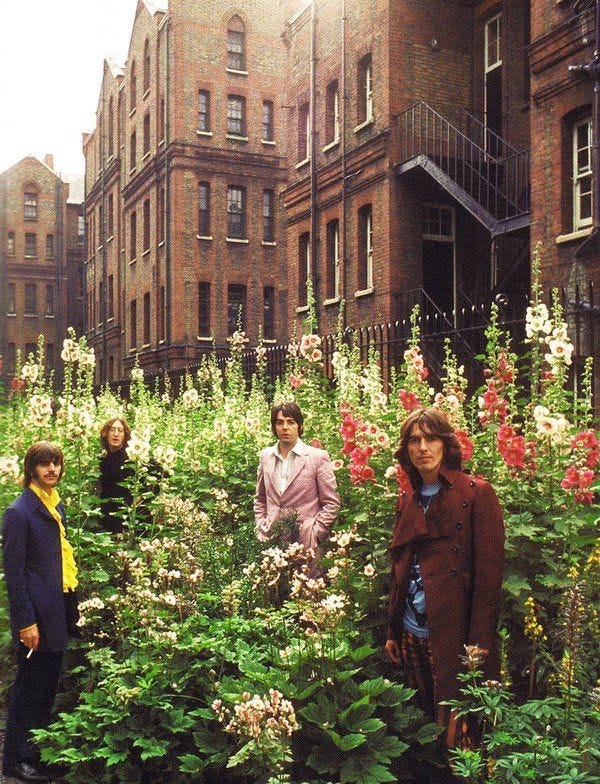
I was there just the other day and set out to see if I could find the location of that picture. The pollution-stained brickwork of the St Pancras Hospital, formally the St Pancras Union Workhouse in 1848, is still largely intact in all its grim Dickensian-glory. I find it utterly atmospheric, but I wouldn’t like to have my tonsils taken out there. The sound of construction nearby though suggests a replacement hospital is being built, and the old structure will soon be heading for the wrecking ball – so catch it while you can.
I found the fire-escape you can see in the background of the photo still standing. And what about the Hollyhocks? Although the flowerbeds have been considerably tamed since 1968, a handful of hollyhocks did still tower triffid-like over the greenery below. The extraordinary descendants, I suppose, 57-summers removed, from the plants The Beatles once stood amongst.
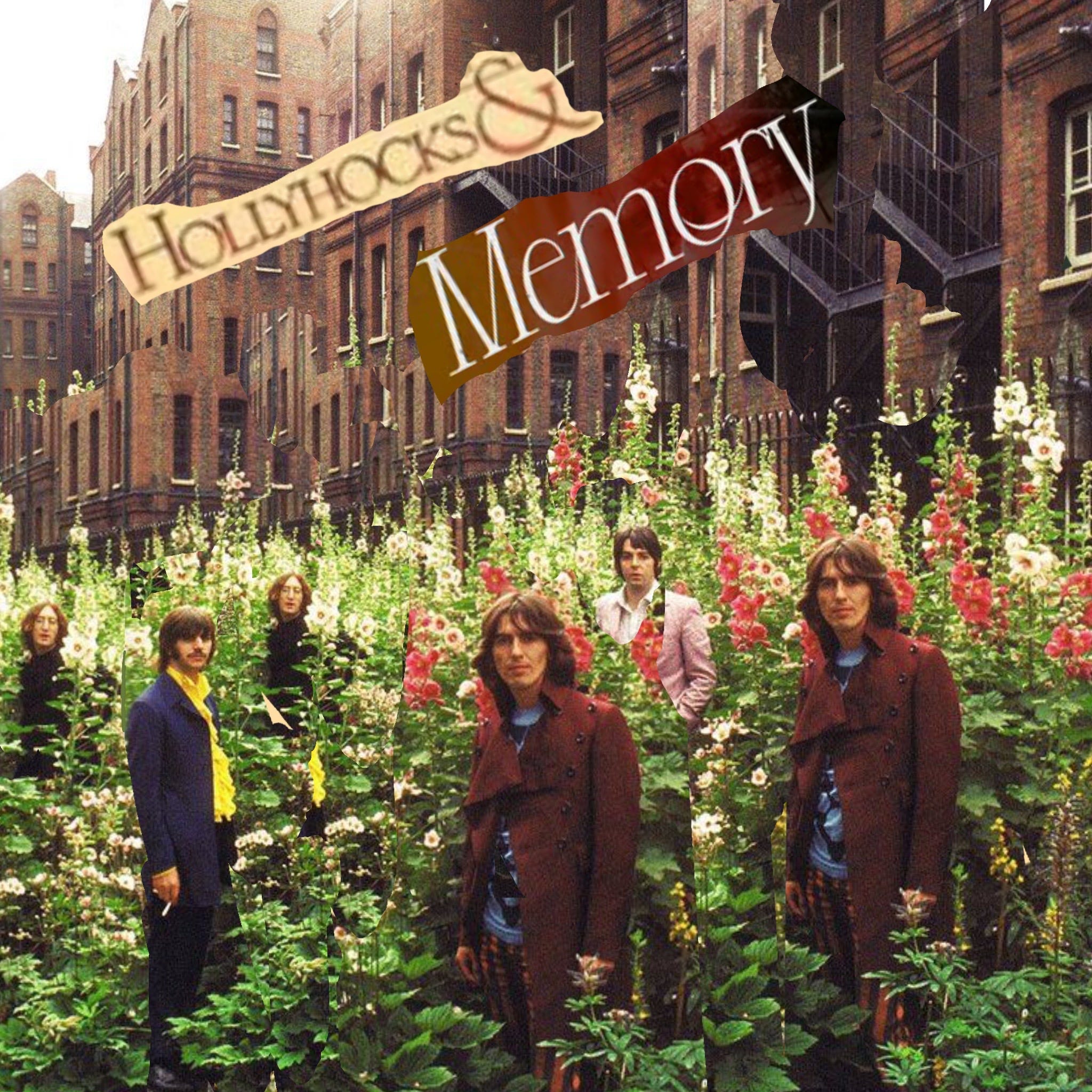
The dark hospital brickwork. The hollyhocks. The hot summer’s day I saw them on. Those are all images out of time. 1848. 1968. 2025. With some imagination, that is time travel, isn’t it? The creation of a brief, short lived, new universe in the mind’s eye. The coming together of two distinct moments of time, into my present, just for a moment.
------
In a diary entry for June 1850 Micheal Faraday, the physicist, described the assent of a balloon he witnessed in the Vauxhall area of London, depicting a series of unlikely momentary images coming together in a single moment and then disappearing.
“The evening was very clear, and the Sun bright: the balloon was very high, so that I could not see the car from Queen Square, Bloomsbury, and it looked like a golden ball. Ballast was thrown out two or three times and was probably sand; but the dust of it had this effect, that a stream of golden cloud seemed to descend from the balloon, shooting downwards for a moment, and then remained stationary, the balloon and it separating very slowly.
It shows the wonderful manner in which each particle of this dusty cloud must have made its impression on the eye by the light reflected from it, and is a fine illustration of the combination of many effects, each utterly insensible alone, into one sum of fine effect.”
The balloon, the golden cloud of dust, the scientific thoughts passing through Faraday’s mind, his memories of past discoveries, past balloon flights, Vauxhall, the sun, Bloomsbury in the summer. And, me thinking of all those images in July 2025, seeing in my mind’s eye something someone long dead saw many Julys ago, in the same city, not even five miles apart.
In the universe of imagery, existing only in the imagination, time travel exists. Random elements from different times and places can come together to make a momentary, magic reality.
------
The London of the Second World War was famously captured in documentary films by Humphrey Jennings of the GPO Film Unit, who someone once called “the only real poet that British cinema has yet produced."
Why? Because of his ability to paint with images in his films and combine them with evocative narrations. In his 1942 film Listen to Britian, he depicts images of the city attempting to rebuild itself after the Blitz, with the following narration:
“After all the blitzes, London still remains a strong and noble and beautiful city, and she is not being left in ruins. Facing St. Paul’s, giant cranes swing metal girders high up over the traffic, and in a thousand places inside its huge circumference, London is being rebuilt in the sunlight.
Now the boom of the traffic is pierced by the shrill fifes of the Marine’s Band and they in their turn are drowned out by the tremendous rhythms of industry: the screaming of the cold chisel and the pounding of the steam hammer.”
How the ages pass in those lines. We’re time travelling again. From the cold chisel to the steam hammer, the quaintness of the fife to the crush of twentieth century industry.
It’s funny to think that the music drowned out by the machinery involved in London’s reconstruction, would itself, in just twenty years’ time be drowned out by rock and roll and The Beatles on their slow journey to St Pancras Old Church Yard, where we just met them.
And the sunlight overlooks it all. The same sunlight that lit Faraday’s balloon. And St. Pauls Cathedral overlooks it too, that most famous of London landmarks.
Humphrey Jennings once wrote of St Paul’s:
“I see London
I see the dome of Saint Paul’s like the forehead of Darwin.”
Some people have concluded that the designer of the ceiling of St. Paul’s surreptitiously snuck references to Darwin’s theory of evolution into the mosaics.
And Faraday once depicted a vision in his diary of an optical illusion that prompted “rays of darkness” to leap upward from the dome of St. Paul’s, an image which appeared in Humprey Jenning’s mind like a huge war-time radar pulsing in the moonlight, across the night sky.
What a collection of images. What a momentary tumble through time. Time travel doesn’t exist, but when you think about it, it really does.
This was awesome! Thank you for writing it ☺️ particularly loved “In the universe of imagery, existing only in the imagination, time travel exists. Random elements from different times and places can come together to make a momentary, magic reality.” Awesome 👏